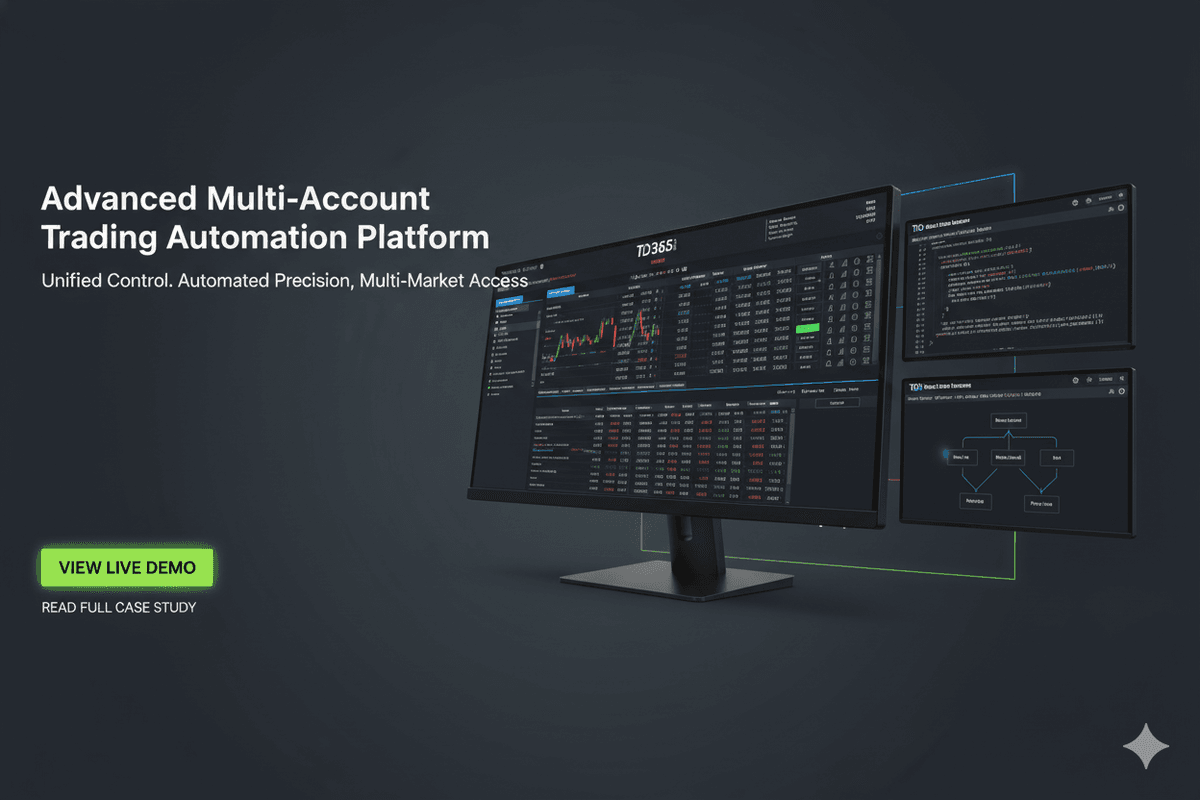
Building a multi-account trading automation platform
The problem
Trading desks often juggle multiple accounts, partial exits, and stop-loss rules across platforms that were never designed for bulk operations. Manual workflows break under volume—and every missed update costs money.
We built a trading automation system that lets operators manage portfolios, execute orders, and monitor markets from one dashboard while a Python automation layer handles browser-based execution at scale.
Architecture that actually ships
The platform splits cleanly into three layers:
- React 18 frontend with Redux Toolkit and Material-UI for account dashboards, order flows, and CSV import/export
- Node.js / Express backend with REST APIs for accounts, orders, and trades—validation and error handling baked in from day one
- Python FastAPI + Selenium workers for headless Chrome automation, session management, and anti-detection patterns
MongoDB stores operational state. Socket.IO pushes live order status and account sync so traders never refresh a page hoping for updates.
What made the difference
Multi-account management without chaos
CSV import/export, primary/secondary account roles, and concurrent operations via multi-threading let teams scale from a handful of accounts to dozens without rewriting the core.
Real-time beats polling
WebSocket updates for order status and account sync removed the "did it fill?" anxiety. When money moves fast, latency in the UI is a product bug—not an infra nice-to-have.
Automation resilience
Selenium sessions fail. Browsers update. Platforms change DOMs. We invested in session recovery, anti-detection measures, and structured error reporting so operators trust the bot instead of babysitting it.
Takeaways for your next build
- Separate UI, API, and automation—each layer can be deployed, scaled, and debugged independently
- Design for bulk ops early—CSV pipelines and role models are cheaper at the start than bolted on later
- Treat real-time as a requirement—not a Phase 2 feature—for any ops-heavy dashboard
If you are planning a FinTech automation product, contact us to scope architecture before you commit to the wrong split between web and bot layers.